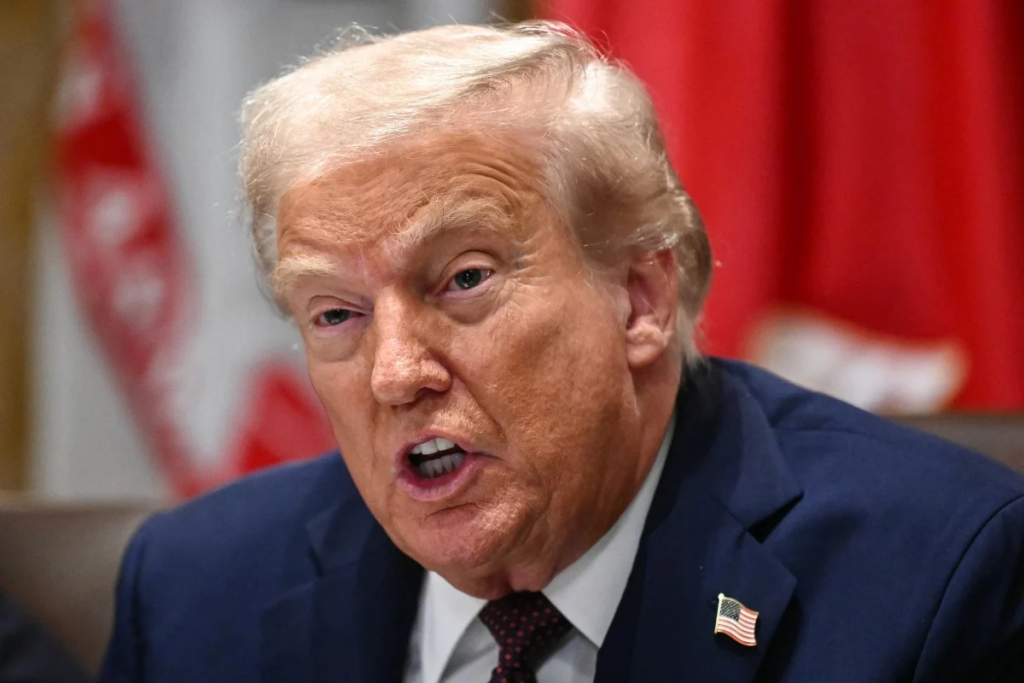
US President Donald Trump speaks during a cabinet meeting in the Cabinet Room of the White House in Washington, DC on August 26, 2025.
By Frontline Reporters
Nigeria’s exports to the United States declined by about N940.98 billion in the first nine months of 2025, even as imports from the US more than doubled, reversing the trade surplus Nigeria recorded a year earlier, according to data from the National Bureau of Statistics (NBS).
NBS foreign trade figures show that Nigeria exported goods worth N3.65 trillion to the US between January and September 2025, down from N4.59 trillion in the same period of 2024—a drop of 20.5 per cent. In contrast, imports from the US surged to N6.80 trillion from N3.01 trillion, representing an increase of 125.5 per cent.
As a result, Nigeria recorded a trade deficit of about N3.15 trillion with the US in the first nine months of 2025, compared with a trade surplus of N1.57 trillion in the corresponding period of 2024.
The downturn coincided with the implementation of a new “reciprocal” tariff regime by Washington under US President Donald Trump, which raised Nigeria’s tariff rate from 14 per cent to 15 per cent. Although crude oil exports were largely exempted, the higher duties affected several non-oil Nigerian exports, dampening demand.
Quarterly data indicate a sharp reversal in 2025. Exports fell steadily from N1.54 trillion in Q1 to N1.36 trillion in Q2, before plunging to N743.63 billion in Q3. Imports moved in the opposite direction, rising from N1.42 trillion in Q1 to N2.16 trillion in Q2, and further to N3.22 trillion in Q3, significantly widening the trade gap.
Year-on-year figures show that while exports to the US rose by 17.7 per cent in Q1 2025, they declined by 14.3 per cent in Q2 and dropped sharply by 56 per cent in Q3. Imports increased across all quarters, leading to the United States dropping out of Nigeria’s top five export destinations by mid-2025, despite remaining one of its largest import sources.
Reacting to the development, President Bola Tinubu said Nigeria would remain resilient despite shifts in US trade policy, noting that growing non-oil revenues would help cushion external shocks. He said Nigeria’s economic reforms and diversification efforts would reduce dependence on any single market.
Also speaking, the Minister of Industry, Trade and Investment, Jumoke Oduwole, said Nigeria would not rush into retaliatory measures but would focus on reforms, regional trade under the African Continental Free Trade Area, and expanding non-oil exports.
Experts have also urged Nigeria to see the tariffs as an opportunity to diversify export markets and strengthen trade ties beyond the United States, while reducing vulnerability to external policy changes.
ADVERTISEMENTS