
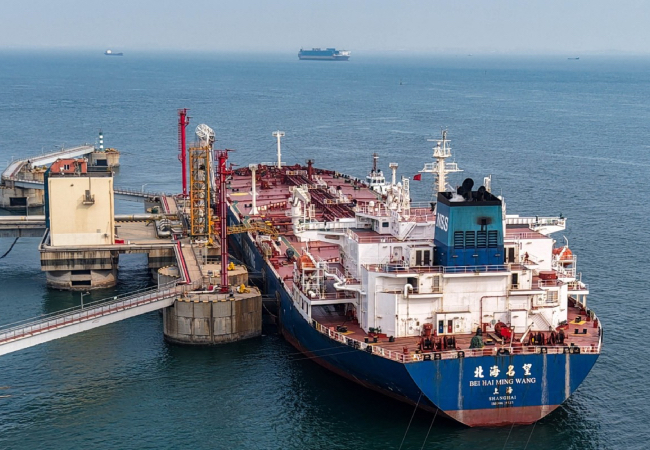
An oil tanker unloads crude oil at a terminal at the port in Qingdao, in China’s eastern Shandong province on March 11, 2026.
Global oil prices spiked above $100 per barrel on Thursday as renewed Iranian attacks on energy infrastructure and shipping in the Gulf heightened fears of a major supply disruption, overshadowing a massive release of emergency crude reserves by leading economies.
The surge came as tensions escalated in the Middle East, with energy markets rattled by reports of strikes on oil tankers and shipping routes in the Persian Gulf.
The International Energy Agency (IEA) warned that the ongoing conflict in the region is triggering the largest supply disruption in the history of the global oil market. The agency made the assessment a day after member countries agreed to release 400 million barrels of oil from strategic reserves, the biggest coordinated release ever.
Despite the move, markets remained volatile amid concerns that supply flows could be severely restricted, particularly through the Strait of Hormuz — a critical waterway that handles about 20 percent of global crude shipments. Iranian retaliatory attacks on vessels and Gulf targets have effectively shut down traffic through the strait.
Fresh violence in the region worsened the situation. An attack on two oil tankers off Iraq reportedly killed at least one crew member, while another cargo ship caught fire after being struck by shrapnel.
In its latest market report, the IEA said global crude output has dropped by at least eight million barrels per day, with an additional two million barrels of petroleum products disrupted, representing roughly 7.5 percent of total daily supply.
The price of Brent crude oil, the global benchmark, climbed as high as $101.59 per barrel before slightly easing.
Prices briefly dipped but rose again after Donald Trump said preventing Iran from obtaining nuclear weapons was more important than controlling oil prices.
At around $100 per barrel, Brent is now about 38 percent higher than it was before the conflict erupted 13 days ago, when the United States and Israel launched airstrikes against Iran.
Energy analysts say the latest developments are rattling global markets.
According to David Morrison of Trade Nation, reports of Iranian attacks on shipping and missile strikes across the region have intensified uncertainty in energy markets.
He added that Washington’s inability to quickly reopen the Strait of Hormuz and secure shipping routes highlights the limits of US control over the region’s energy corridors.
The IEA said the release of strategic reserves is equivalent to roughly 20 days of oil supplies normally transported through the Strait of Hormuz, but analysts warn the move has so far failed to calm markets.
“If the reserve releases were meant to cap oil prices, they clearly didn’t succeed,” Morrison noted.
The spike in fuel costs is already affecting industries worldwide. Airlines are beginning to adjust operations as jet fuel prices climb.
National carrier Air New Zealand announced plans to cancel 1,100 flights over the next two months, while Cathay Pacific introduced new fuel surcharges on most routes. Meanwhile, Air France-KLM said it would increase ticket prices to offset rising fuel costs.

Market analysts warn the prolonged surge in oil prices could trigger a broader economic shock.
Kathleen Brooks, research director at trading firm XTB, said sustained high energy prices could intensify global inflation.
“The longer oil remains elevated, the more damaging and long-lasting the inflation shock will be for the global economy,” she said.
Financial markets also reacted negatively. Major stock indices on Dow Jones Industrial Average, S&P 500 and Nasdaq Composite fell at the opening bell in New York, while most European and Asian markets also closed lower.
At the same time, the US dollar strengthened against major currencies as investors sought safer assets amid rising geopolitical uncertainty.
ADVERTISEMENTS