


By Frontline Reporters
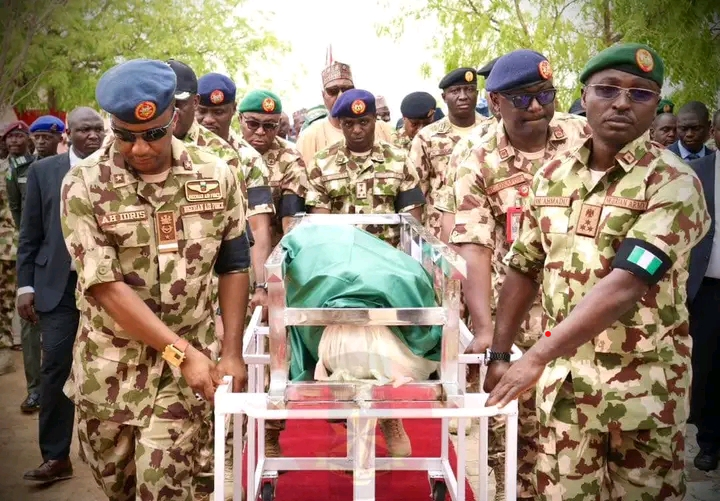
Nigeria’s battle against insurgency took a solemn turn as the military laid to rest Brigadier General Oseni Braimah, Captain Ismail, and other soldiers killed in recent attacks in Borno State—just as troops successfully repelled another attempted assault by terrorists.
The fallen officers, including the late Commander of the 29 Joint Task Force Brigade, died during coordinated attacks on April 9 by suspected Boko Haram and Islamic State West Africa Province (ISWAP) fighters. The insurgents had launched simultaneous strikes on military positions in Benisheikh, a strategic town along the Maiduguri-Damaturu highway.
In a statement released Wednesday, the Nigerian Army confirmed that the slain personnel were buried with full military honours at the Maimalari Cantonment Cemetery in Maiduguri.
Describing the ceremony as “solemn and emotionally charged,” the Army paid tribute to the courage and sacrifice of the deceased.
“These gallant soldiers paid the supreme price in the line of duty. Their sacrifice reminds us daily of the cost of safeguarding Nigeria’s peace and unity,” the statement read.
Amid tears from grieving families and comrades, the fallen heroes were honoured for their unwavering commitment to national security. Dignitaries at the burial included Borno State Governor Babagana Zulum, the Minister of Defence, senior military chiefs, and other top officials, all of whom hailed the soldiers as patriots who stood firm in the face of danger.
While the nation mourned, troops of the 115 Task Force Battalion were simultaneously engaged in fresh combat, successfully repelling another terrorist attack on Wednesday. However, the clash came at a cost, with four soldiers reportedly killed in Askira Uba after a fierce gun battle that lasted nearly an hour.
Military sources revealed that the attackers were heavily armed and initially caught the troops off guard, though the soldiers resisted bravely.
Elsewhere in Borno, tensions escalated in Monguno, where troops allegedly set fire to parts of the Charlie 2 community over suspicions of collaboration with insurgents following a deadly ambush that claimed the life of a commanding officer and six soldiers. The operation was later halted after intervention by senior authorities, with dialogue efforts underway.
Beyond Borno, security concerns continue to ripple across the country. In Benue State, police have intensified clearance operations to flush out criminal elements, warning that anyone aiding bandits or terrorists would face severe consequences.
Meanwhile, pressure is mounting on the Federal Government to adopt tougher measures. The Arewa Consultative Forum described the security situation as a “state of war,” urging a complete overhaul of national priorities to focus on ending the crisis.
Similarly, Afenifere called for stronger regional security, urging South-West governors to reinforce the Amotekun Corps and accelerate plans for state policing.

Adding an international dimension, a United States lawmaker, Kimberly Daniels, called for the redeployment of the Minister of State for Defence, citing concerns over accountability and the worsening security situation.
A recent report by the National Institute for Legislative and Democratic Studies underscores the gravity of the crisis, recording 345 deaths and 361 abductions in March alone, with terrorism accounting for the majority of fatalities.
As insurgents intensify attacks—now increasingly targeting military formations and senior officers—the cost of Nigeria’s security battle continues to rise, both on the frontlines and within communities caught in the crossfire.
For many Nigerians, the message is stark: the fight is far from over, and the price of peace remains painfully high.
ADVERTISEMENTS













2026-04-15