
BY GODWIN OBI
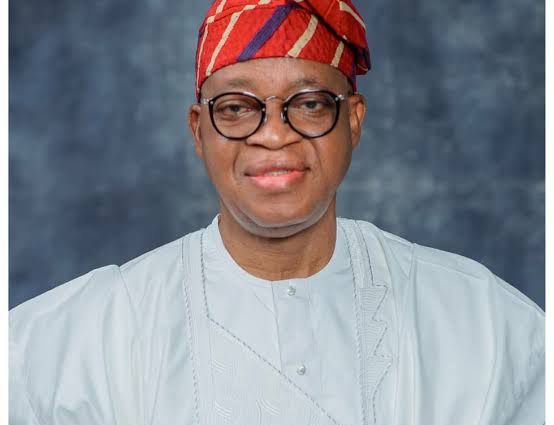
In a high-stakes budget defense on Tuesday, Chief Adegboyega Oyetola, the Minister of Marine and Blue Economy, revealed a staggering truth: the N11.7 billion allocated for his Ministry in the 2025 budget is far from sufficient to address Nigeria’s vast marine economy challenges.
Oyetola, addressing a Joint Committee of the Senate on Marine Transport and House Committees on Ports, Shipping, and Inland Waterways, revealed that his Ministry had already expended an overwhelming N9.97 billion out of the N10.8 billion allocated for capital expenditure in 2024—leaving just N874 million for 2025. Yet, the Minister ominously warned that the N11.7 billion allocated for 2025, along with the N453.8 million overhead, will barely scratch the surface in tackling Nigeria’s marine infrastructure decay, growing maritime security issues, and the chronic shortage of fish production.
In a candid moment, Oyetola described the 2025 budget, dubbed “Budget of Restoration: Securing Peace, Rebuilding Prosperity,” as insufficient for achieving the Ministry’s ambitious goals. He emphasized that key priorities like port infrastructure development, fishery production expansion, maritime safety improvements, and a massive boost in the Ministry’s digital capabilities all depend on much larger financial backing.
But the Minister didn’t stop there. He exposed serious gaps in the current funding system for his Ministry’s agencies, with only three—NPA, NIMASA, and NSC—being fully self-sustaining and contributing significant revenues to the government. Agencies like the National Inland Waterways Authority (NIWA) and Maritime Academy of Nigeria rely on a mix of federal funding and internal revenue, further stretching the Ministry’s capacity to act.
In a heated exchange, Oyetola passionately urged lawmakers to address a critical oversight: the Council for the Regulation of Freight Forwarding in Nigeria (CRFFN) had been wrongly placed under the Federal Ministry of Transport, despite his repeated requests for its inclusion under the Ministry of Marine and Blue Economy. He expressed hope that the lawmakers would correct this error in the final budget.
In a jaw-dropping revelation, Oyetola also disclosed that, despite facing numerous challenges in 2024, the Ministry had laid down the groundwork for a transformative Blue Economy sector. Among the Ministry’s key accomplishments was the completion of critical policy documents, including Nigeria’s National Blue Economy Strategy, which is expected to serve as the backbone for future marine sector governance.
Looking forward to 2025, Oyetola outlined ambitious plans to develop dry ports in Ogun and Oyo States, designed to alleviate congestion at the Western Ports. Additionally, with the increasing number of boat accidents on Nigeria’s inland waterways, the Ministry is launching an aggressive safety program—distributing life jackets and replacing outdated boats with safer, standardized crafts. However, the Minister pointed out that funding delays had crippled some of these initiatives in 2024.
As Oyetola wrapped up his presentation, he made a strong plea for a significant increase in funding. “The capital budget of N11.7 billion, while appreciated, will not suffice to turn the tide for Nigeria’s blue economy,” he declared. “We need a quantum leap in investment to truly unlock the potential of our maritime resources.”
With the clock ticking on final budget approvals, Oyetola’s bold statements left lawmakers grappling with the harsh reality that Nigeria’s maritime sector may remain adrift without a substantial financial commitment to turn it around. Will the 2025 budget deliver the necessary resources, or will it leave the Ministry sailing into another year of underfunding and unrealized potential? Only time will tell.
ADVERTISEMENTS:









Pythrocin distributed by Pinnacle Health Pharmaceuticals Ltd




