
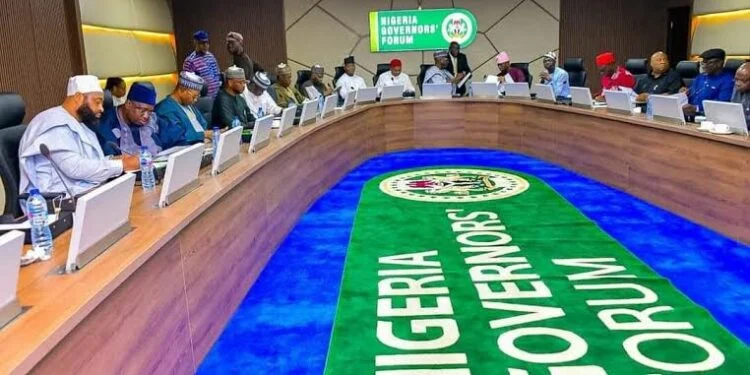
Despite receiving an estimated ₦9 trillion in Federation Account Allocation Committee (FAAC) inflows in 2025, state governors are facing growing criticism from labour unions, civil society organisations and opposition parties over what many describe as a widening disconnect between rising revenues and the lived realities of citizens.
An analysis of Federation Account disbursement data published by the National Bureau of Statistics and collated by Frontline Reporters shows that FAAC allocations to states rose sharply in 2025, underscoring the scale of the revenue windfall that accrued to subnational governments amid higher federation inflows.
State governments received ₦7.315 trillion directly from FAAC in 2025, up from ₦5.186 trillion in 2024—an increase of about ₦2.13 trillion, or 41 per cent. When constitutionally mandated 13 per cent derivation revenue is included, total inflows attributable to states rose to ₦8.934 trillion, compared to ₦6.533 trillion in 2024, representing a ₦2.4 trillion or 36.7 per cent increase.
The surge came amid a broader expansion in total FAAC distributions to all tiers of government, which rose from ₦15.259 trillion in 2024 to ₦21.897 trillion in 2025. Without derivation, states accounted for about 33.4 per cent of total FAAC disbursements in 2025, slightly lower than their 34.0 per cent share in 2024. Including derivation, state-linked receipts represented 40.8 per cent of total disbursements, down from 42.8 per cent a year earlier.
Monthly data show that allocations to states improved steadily throughout 2025. States received ₦498.50 billion in January, compared with ₦396.69 billion in January 2024. Allocations peaked at ₦727.17 billion in October before easing to ₦601.73 billion in December. By mid-year, states had already received over ₦3.32 trillion, easing short-term liquidity pressures, particularly for states with large wage bills and debt obligations.
Derivation revenue also increased significantly, rising to ₦1.619 trillion in 2025 from ₦1.347 trillion in 2024. Monthly derivation payments were especially strong in September 2025, when oil-producing states shared ₦183.01 billion, compared to ₦99.47 billion in the same month of 2024.
Although allocations to the Federal Government and local governments also rose during the year, analysts note that the impact on states is particularly important given their constitutional responsibility for education, healthcare and infrastructure. The additional ₦2.4 trillion received by states in 2025 alone is nearly half of what they received from FAAC in total in 2024.
A recent BudgIT State of States Report revealed that over 30 states remain heavily dependent on FAAC allocations. According to the report, 31 states relied on FAAC for at least 80 per cent of their recurrent revenue, while 29 states depended on FAAC for more than half of their total revenue.
BudgIT warned that rising FAAC inflows may be discouraging states from expanding internally generated revenue (IGR). The report noted that the share of IGR in total recurrent revenue declined from 25.27 per cent in 2023 to 20.27 per cent in 2024, pointing to continued dependence on federal transfers.
Economists have echoed these concerns. The Managing Director of Optimus by Afrinvest, Dr Ayodeji Ebo, said FAAC revenues are volatile and largely outside state control, making budgets vulnerable to oil price shocks and discouraging innovation in local revenue generation.
Similarly, development economist Dr Aliyu Ilias said weak revenue management at the subnational level continues to undermine the benefits of higher allocations. He warned that rising FAAC inflows are not automatically translating into improved living standards and called for incentive-based frameworks that reward states for boosting IGR.
Labour, CSOs Raise Alarm
The Nigeria Labour Congress (NLC) said increased FAAC allocations have failed to deliver meaningful welfare gains for citizens, blaming weak governance, misplaced priorities and corruption.
The Assistant Secretary-General of the NLC, Onyeka Christopher, said many states had little to show for the funds received, warning that the absence of consequences for financial mismanagement continues to undermine development.
Civil society organisations also expressed concern. Chairman of the Centre for Accountability and Open Leadership, Debo Adeniran, said the rise in allocations had expanded financial opportunities for governors without corresponding benefits for citizens.
The Executive Director of CISLAC, Auwal Musa Rafsanjani, said there was little physical or verifiable evidence that increased revenues were improving healthcare, electricity, infrastructure or agriculture across many states.
Opposition Parties React
Opposition parties across several states also questioned the developmental impact of higher federal allocations. In Lagos State, the African Democratic Congress said rising allocations and IGR had failed to ease hardship, citing soaring rents and inadequate social services.
In Sokoto, the Peoples Democratic Party accused the state government of concentrating development in only a few local government areas, while neglecting critical sectors such as water supply, health and education.
Opposition figures in Plateau, Bauchi, Zamfara, Kebbi and Gombe states similarly argued that increased FAAC inflows had not translated into visible development, accusing state governments of prioritising political interests and high-profile projects over citizens’ welfare.
Mixed Assessments
In contrast, the Labour Party in Nasarawa State commended the state government for infrastructure development, citing major road projects and the completion of the Lafia flyover as evidence of effective use of funds.
In Kwara State, the ruling APC and opposition PDP traded blame over the impact of rising allocations, with the government insisting that investments had been spread across infrastructure, education, healthcare and social programmes statewide.
As FAAC inflows remain at historically high levels, analysts and civil society groups say the central challenge is no longer revenue availability, but governance, transparency and accountability, warning that without reforms, rising allocations may continue to deliver limited improvements in citizens’ welfare.
ADVERTISEMENTS