

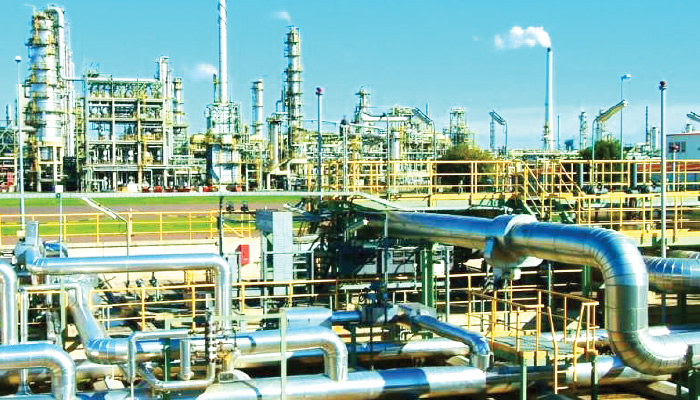
File photo: Dangote Refinery
BY FRONTLINE REPORTERS
A major battle for control of Nigeria’s downstream petroleum market is unfolding as the Nigerian National Petroleum Company Limited has strongly opposed moves by the Dangote Petroleum Refinery and Petrochemicals to halt fuel importation into the country, warning that granting such requests could hand the refinery monopoly control over the nation’s petroleum supply chain.
The dispute, now before the Federal High Court in Lagos, has exposed deep divisions within Nigeria’s oil and gas sector over fuel pricing, market competition, local refining capacity, and the future direction of the country’s deregulated petroleum industry.
In a counter-affidavit filed before the Federal High Court, Lagos Judicial Division, the NNPC argued that petroleum products from the Dangote refinery are already sold at “significantly high and fluctuating market prices,” insisting that continued fuel importation remains necessary to guarantee energy security, market stability, and competitive pricing.
The national oil company urged the court to dismiss the suit filed by the Dangote refinery, describing it as incompetent, premature, and an abuse of court process.
The legal confrontation stems from a suit instituted by the Dangote refinery against the Attorney-General of the Federation, the Nigerian Midstream and Downstream Petroleum Regulatory Authority, and the NNPC over the continued issuance of petrol import licences to marketers and oil trading firms.
The refinery had challenged the decision of the Nigerian Midstream and Downstream Petroleum Regulatory Authority to approve the importation of more than 700,000 metric tonnes of petrol despite claims that the Lekki-based refinery currently supplies over 90 per cent of Nigeria’s daily petrol consumption.
The refinery argued that the continued approval of import licences undermines local refining efforts and violates existing regulations as well as previous court directives to maintain the status quo.
The development marks another major escalation in the growing rivalry between Dangote refinery and major stakeholders in Nigeria’s downstream oil sector since the commencement of operations at the multibillion-dollar refinery.
The refinery, owned by billionaire businessman Aliko Dangote, had previously accused government agencies and importers of sabotaging its operations through continued fuel importation and alleged obstacles surrounding crude oil supply arrangements.
Dangote refinery maintained that it possesses sufficient refining capacity to meet Nigeria’s domestic demand for petrol, diesel, and aviation fuel, insisting that continued importation weakens local refining investments and discourages industrial growth.
However, the NNPC sharply disagreed.
In its affidavit before the court, the national oil company argued that the refinery had failed to provide independently verified evidence showing that it could consistently satisfy Nigeria’s nationwide fuel requirements.
“There is no credible, independent, or verifiable evidence before this honourable court establishing that the plaintiff presently satisfies the petroleum product demands of Nigeria,” the NNPC stated.
The company further argued that refining capacity alone is insufficient to guarantee national energy security, stressing that fuel supply obligations involve a much broader chain that includes logistics, transportation, strategic reserves, product evacuation, haulage, and nationwide distribution networks.
According to the NNPC, relying heavily on a single supplier poses serious risks to the country’s energy stability.
“Reliance on a single supplier within the petroleum industry poses grave risks to national energy security,” the affidavit stated.
The oil company warned that restricting imports in the manner sought by the refinery could expose Nigeria to widespread fuel shortages, distribution failures, supply disruptions, and severe price instability.
“Restricting importation channels in the manner sought by the plaintiff would expose Nigeria to severe risks of petroleum shortages, supply disruptions, price instability, distribution failures, and national energy crises,” the affidavit read.
The NNPC also argued that any operational shutdown, maintenance disruption, or production challenge affecting the Dangote refinery could trigger a nationwide supply crisis if alternative import channels are eliminated.
According to the company, the refinery’s legal demands appear aimed at restricting or eliminating other participants within the petroleum importation and distribution chain.
“The grant of the plaintiff’s reliefs would effectively expose Nigeria’s petroleum sector to monopoly control and undermine competitive participation within the industry,” the company argued.
The NNPC further maintained that the continued issuance of import licences remains lawful under the Petroleum Industry Act and does not violate any existing law.
The company specifically referenced Sections 317(8) and 317(9) of the Petroleum Industry Act, arguing that the law grants regulatory authorities discretionary powers regarding backward integration policies and does not impose a total ban on fuel importation.
“Section 317(8) of the Petroleum Industry Act merely provides that the Authority may apply a Backwards Integration Policy in the downstream petroleum sector, thereby conferring discretionary powers on the regulatory authorities rather than imposing a mandatory prohibition on petroleum importation,” the affidavit stated.
The national oil company also dismissed allegations that it deliberately frustrated Dangote refinery operations or denied the refinery access to crude oil supplies.
“Contrary to the plaintiff’s allegations, the 2nd Defendant has not sabotaged the plaintiff’s refinery operations,” the company said.
According to the NNPC, crude oil allocation and supply arrangements are influenced by multiple commercial and operational realities, including security considerations, logistics, production levels, contractual obligations, and market dynamics.
The court battle has also attracted strong reactions from petroleum marketers, who have largely aligned with the NNPC’s position in support of a liberalised and competitive downstream market.
The National President of the Petroleum Products Retail Outlet Owners Association of Nigeria, Billy Gillis-Harry, argued that competition remains essential for ensuring product availability, efficiency, price moderation, and long-term sustainability in the sector.
According to him, Nigeria’s downstream petroleum market must not be allowed to tilt toward monopoly control regardless of the scale of investment made by any single operator.
He acknowledged the massive investment made by the Dangote refinery and praised its contribution to local refining capacity, employment generation, and reduction in import dependence.
However, he stressed that maintaining multiple supply channels remains critical to preventing supply shocks, artificial scarcity, and exploitative pricing.
“One of the benefits of healthy competition in the downstream petroleum sector is the reduction in fuel prices through competitive pricing,” Gillis-Harry stated.
He warned that monopoly control could result in arbitrary pricing, reduced efficiency, limited consumer choices, and excessive market dominance.
The PETROAN president therefore defended the issuance of import licences as both lawful and necessary for ensuring uninterrupted fuel availability across the country.
Meanwhile, local refiners under the umbrella of the Crude Oil Refineries Association of Nigeria have strongly opposed continued fuel importation, arguing that indigenous refiners have demonstrated far greater commitment to Nigeria’s downstream petroleum sector than importers.
CORAN’s Publicity Secretary, Eche Idoko, argued that commitment to the sector should be measured by long-term capital investment and industrial risk exposure rather than trading activity.
“Who has truly demonstrated faith in Nigeria’s downstream sector—local refinery companies or petroleum importers? The answer is grounded in evidence, capital behaviour, and long-term commitment,” the association stated.
CORAN noted that refinery operators have committed enormous financial resources to building fixed industrial infrastructure within Nigeria despite persistent challenges such as foreign exchange volatility, regulatory uncertainty, logistics constraints, crude oil supply risks, and power supply problems.
The latest legal confrontation highlights the growing tensions within Nigeria’s deregulated petroleum market following the removal of petrol subsidies in 2023.
Since deregulation, fuel pricing has increasingly been influenced by market forces, intensifying competition among importers, marketers, refiners, and regulators over pricing, supply control, and market dominance.
The Dangote refinery, which commenced petrol production in 2024 after years of delays and multibillion-dollar investment, has repeatedly pushed for stronger government protection for local refining initiatives.
The refinery has also previously reduced petrol prices multiple times in efforts to gain market share and challenge import-dependent operators, moves that reportedly triggered complaints from some marketers who claimed the reductions negatively affected their businesses.
Industry analysts believe the ongoing court battle could significantly shape the future structure of Nigeria’s downstream petroleum market, particularly regarding import policies, competition rules, pricing dynamics, and the implementation of the Petroleum Industry Act.
For consumers already grappling with high fuel prices and economic pressure, the outcome of the dispute may ultimately determine whether Nigeria’s petroleum sector evolves into a fully competitive market or becomes increasingly dominated by a few major operators.
ADVERTISEMENTS









2026-05-25