

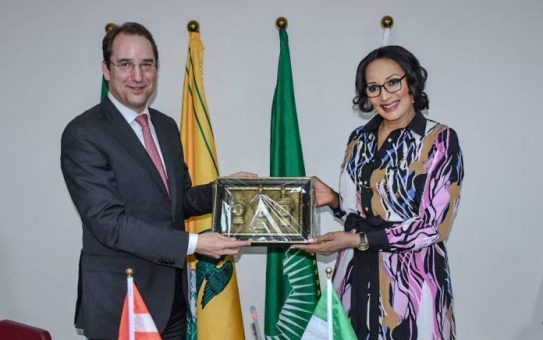
BY GODWIN OBI
Nigeria and Austria have agreed to strengthen bilateral relations, deepen multilateral engagement, and expand cooperation across key strategic sectors of mutual interest.
The commitment was reached during a high-level meeting between Nigeria’s Minister of State for Foreign Affairs, Ambassador Bianca Odumiegwu-Ojukwu, and Austria’s Secretary-General of the Federal Ministry for International and European Affairs, Nikolaus Marschik, held on Thursday, January 22, 2026.
According to a statement issued by the Ministry of Foreign Affairs, the meeting provided an opportunity for both sides to review the trajectory of Nigeria–Austria relations, exchange perspectives on emerging global and regional challenges, and identify practical areas for enhanced cooperation.
The discussions took place against the backdrop of evolving geopolitical realities, economic realignments, and shared security concerns affecting Europe, Africa, and the wider international system, underscoring the importance of sustained diplomatic engagement.
Odumiegwu-Ojukwu expressed Nigeria’s appreciation for Austria’s long-standing partnership, noting that bilateral relations have remained cordial for more than five decades. She recalled Austria’s historical diplomatic presence in Nigeria and acknowledged the contributions of past Austrian envoys in strengthening institutional and people-to-people ties.
She noted that cultural familiarity and mutual goodwill have continued to foster positive perceptions and enduring affinity between both countries.
Highlighting Nigeria’s priorities, the minister stressed the country’s interest in expanding economic cooperation with Austria, particularly in trade and investment. She identified renewable energy, green and environmental technologies, food security, agro-processing, infrastructure development, digital innovation, and information and communications technology as priority sectors where Austrian expertise could support Nigeria’s development agenda.
She encouraged Austrian businesses to explore opportunities within Nigeria’s Special Economic Zones and leverage the African Continental Free Trade Area as a gateway to broader regional markets, noting that ongoing economic reforms are aimed at attracting long-term, value-driven investment.
Cultural, educational, and academic cooperation also featured prominently in the talks. Odumiegwu-Ojukwu referenced existing agreements on cultural exchange and noted growing interest among Nigerian students and professionals in Austrian educational institutions.
She expressed Nigeria’s readiness to expand scholarship programmes, academic partnerships, and collaboration between universities, research centres, and cultural institutions, describing education and cultural diplomacy as pillars of sustainable bilateral relations.
On security, the minister briefed the Austrian delegation on Nigeria’s efforts to combat terrorism, violent extremism, and organised crime, particularly in the Sahel and West African sub-region. She outlined Nigeria’s collaboration with international partners to counter insurgency, rebuild post-conflict communities, support displaced persons, and strengthen intelligence-sharing and capacity-building frameworks.
She emphasised that terrorism and insecurity are global challenges requiring collective action and sustained international cooperation.
Migration management was also discussed, with Nigeria advocating balanced and humane approaches that promote orderly migration while addressing root causes such as unemployment, skills gaps, and socio-economic pressures. Odumiegwu-Ojukwu highlighted Nigeria’s interest in skills development, vocational training, and structured mobility initiatives that enable knowledge exchange rather than brain drain.
In his response, Marschik reaffirmed Austria’s respect for Nigeria’s leadership role in Africa, describing the country as one of Austria’s most important partners on the continent. He disclosed that Austria is developing a comprehensive Africa strategy anchored on equality, mutual respect, and shared learning.
He said the strategy aims to harmonise Austria’s engagement across peace and security, economic cooperation, migration and mobility, education, science, culture, and environmental protection, guided by African continental priorities and global sustainable development goals.
Multilateral cooperation and the defence of a rules-based international order formed a central theme of the meeting. The Austrian delegation highlighted Austria’s role as a neutral host of major international organisations and expressed appreciation for Nigeria’s support for Austria’s bid for a non-permanent seat on the United Nations Security Council, assuring reciprocal support for Nigeria’s future multilateral aspirations.
Odumiegwu-Ojukwu reaffirmed Nigeria’s commitment to multilateralism, dialogue, and diplomacy as essential tools for managing global crises and preserving international peace and security. She also shared Nigeria’s perspectives on regional challenges in West Africa, including issues of constitutional governance, regional integration, and collective security.
Both sides agreed that regional instability, whether in Africa or Europe, reinforces the need for cooperation among countries committed to international law, peaceful coexistence, and institutional dialogue.
The meeting concluded with a reaffirmation of both countries’ readiness to work closely to expand bilateral and multilateral cooperation, guided by mutual respect, shared values, and a results-oriented approach.
ADVERTISEMENTS












2026-01-24
