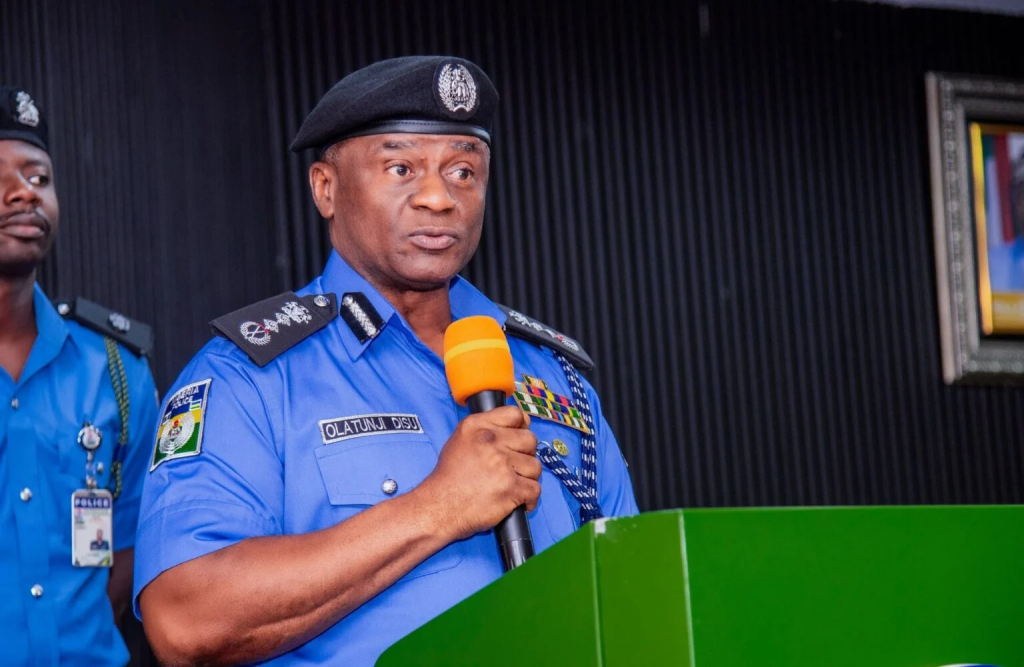
Newly sworn-in Inspector-General of Police, Tunji Disu, on Wednesday inaugurated a special committee to develop a comprehensive framework for the proposed establishment of state police in Nigeria.
The move follows renewed momentum for policing reforms after President Bola Tinubu, during a recent Iftar with senators at the Presidential Villa, Abuja, urged the leadership of the 10th Senate to commence constitutional amendments that would pave the way for decentralised policing.
The President argued that state police would enhance grassroots security, improve rapid response to threats, and address gaps inherent in the country’s centralised policing structure, which he said now requires constitutional review.
Committee to Shape Police Position
Speaking at the inauguration, Disu said the committee would critically examine the concept of state policing as part of broader efforts to strengthen Nigeria’s internal security architecture and deepen community-based policing.
He explained that the panel would review policing models within and outside Nigeria, assess community security needs and emerging threats, and propose an operational framework for the creation and coordination of state police formations.
The committee is also expected to address critical issues such as recruitment, training standards, funding, resource allocation, accountability, and oversight mechanisms to ensure professionalism and public trust.
“Among other responsibilities, the committee will develop robust accountability and oversight mechanisms to guarantee that state police structures operate with integrity and professionalism,” Disu stated.
He noted that properly structured state police formations could provide more localised services focused on neighbourhood patrols, conflict prevention, and early response to security threats.
“This collaborative arrangement will encourage specialisation, strengthen professionalism, and ultimately deliver more effective security outcomes for our citizens,” he added.
The steering committee is chaired by Prof. Olu Ogunsakin, Director-General of the National Institute for Police Studies, Abuja, with Commissioner of Police Bode Ojajuni serving as secretary.
Other members include senior officers of the Force and retired CP Emmanuel Ojukwu.

“We Are Not Afraid” – IG
Shortly after taking the oath of office, Disu revealed that he had set up the committee to articulate the Nigeria Police Force’s institutional position on the state police proposal.
“The committee was set up early this morning to look into the issue of state police from the angle of the Nigeria Police,” he said.
“We don’t want it to appear as if decisions are being taken without the input of the police, who are the primary stakeholders. We want to ensure that the best approach is adopted.”
Emphasising that the Force does not see state police as a threat, Disu described the initiative as a partnership rather than a displacement of roles.
“State police has come to stay, and the police should be able to do their part in making it succeed. The police are not afraid. Our jobs are not being taken. It’s an issue of partnership,” he said.
Swearing-In Ceremony
Disu was formally sworn in at 2:53pm on Wednesday after his citation was read by the State House Director of Information and Public Relations.
The ceremony was witnessed by Vice President Kashim Shettima and other top government officials, including the National Security Adviser, Nuhu Ribadu; Chief of Staff to the President, Femi Gbajabiamila; Minister of Police Affairs, Senator Ibrahim Gaidam; and FCT Minister, Nyesom Wike.
His confirmation came barely a week after President Tinubu appointed him acting Inspector-General following the resignation of his predecessor.
Retired Officers Applaud Move
A retired Assistant Inspector-General of Police, Ali Amodu, described the decision to constitute the committee as “a right step in the right direction.”
According to him, the panel would provide professional insight to guide the Presidency on the implications and modalities of decentralising the Nigeria Police Force.
Amodu disclosed that he had advocated decentralisation as far back as 1981 after returning from detective training in the United Kingdom, though the idea was then met with resistance.
“The concept is gaining global acceptance. What was once controversial is now being recognised as necessary in many parts of the world,” he said.
With the panel now in place, attention shifts to the National Assembly and the constitutional amendment process that could redefine the structure of policing in Nigeria.
ADVERTISEMENTS