


BY FRONTLINE REPORTERS
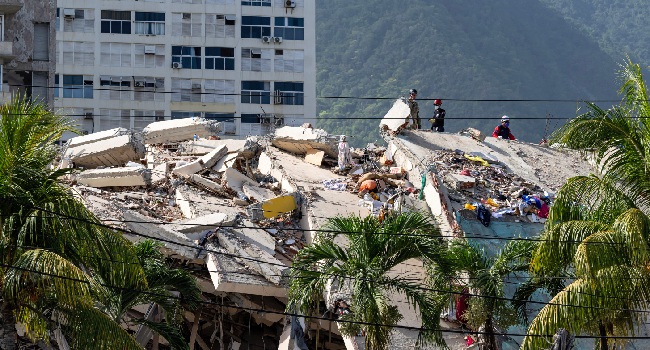
The death toll from Venezuela’s catastrophic twin earthquakes has climbed to 1,430, as rescue teams race against time to locate survivors beneath the rubble of collapsed buildings.
The powerful earthquakes, measuring 7.2 and 7.5 in magnitude, struck on Wednesday, causing widespread destruction across several parts of the country, particularly the coastal state of La Guaira. Authorities fear the number of casualties could rise further, with thousands still unaccounted for.
Humanitarian concerns are mounting as millions of people face shortages of clean water, sanitation facilities, healthcare and emergency shelter. The first United States aid flights have begun arriving in Caracas after one runway at Simon Bolivar International Airport was restored to operation. The US military has also deployed C-17 transport aircraft and a naval vessel to support relief efforts.
The United Nations Office for the Coordination of Humanitarian Affairs (OCHA) said search-and-rescue teams from at least 17 countries have been mobilised to assist local emergency responders in locating survivors trapped beneath collapsed structures.
Despite the international response, many residents have been forced to dig through debris with their bare hands in desperate attempts to rescue loved ones. Disaster experts stress that the first 72 hours following a major earthquake offer the highest chances of finding survivors alive.
A rare moment of hope emerged on Friday when residents in La Guaira rescued a newborn baby from the rubble about 32 hours after the earthquakes struck. Videos shared on social media showed emotional scenes as the infant was carried to safety, drawing widespread attention and relief.
According to the International Organization for Migration (IOM), as many as 6.76 million people may have been affected by the disaster and could require emergency shelter, healthcare, clean water, sanitation services, protection and other essential humanitarian assistance.
National Assembly President Jorge Rodriguez said 3,238 people had been injured in addition to the 1,430 confirmed deaths. The United Nations estimates that physical damage from the disaster could reach $6.7 billion, representing roughly six percent of Venezuela’s gross domestic product.
UN Emergency Relief Coordinator Tom Fletcher warned that the death toll could continue to rise significantly, noting that more than 50,000 people remained missing.
Public Anger Grows
Public frustration has intensified over what many residents describe as a slow and inadequate government response.
Yessica Mendoza recounted how her family recovered the bodies of her daughter, 25-year-old Yesimar Rodriguez, and son-in-law, Jhomel Anaya, from the ruins of their home without assistance from emergency workers.
“We were the ones who pulled them out ourselves. No help ever came,” she told AFP, adding that the couple would be cremated immediately because of the condition of their bodies.
Residents also confronted interim leader Delcy Rodriguez during her visit to one of the devastated neighbourhoods in Caracas, accusing authorities of failing to provide timely assistance.
“The government isn’t doing anything for the people,” some residents shouted from behind security cordons.
Authorities have since restricted access to La Guaira State while deploying additional military personnel to support rescue and security operations.
International Support
Rodriguez said she had spoken with US President Donald Trump and Secretary of State Marco Rubio, who reaffirmed Washington’s commitment to supporting the humanitarian response.
The United States has dispatched more than 250 disaster response personnel, including specialised urban search-and-rescue teams equipped with trained rescue dogs.
The earthquakes struck a country already struggling with years of economic hardship, weakened public services and political instability. Hospitals and critical infrastructure had already been under severe strain before the disaster.
Humanitarian agencies warned that millions of Venezuelans were already facing food insecurity, limited healthcare and inadequate access to basic services before the earthquakes compounded the crisis.
The tragedy has drawn comparisons with some of the world’s deadliest recent earthquakes, including the 2010 Haiti earthquake and the 2005 Kashmir earthquake.
Among those confirmed dead are 28 Portuguese nationals, five Spaniards, two Brazilians, seven Chinese nationals, one Chilean and one Italian-Venezuelan.
Venezuela’s northern coastline lies along the boundary between the Caribbean and South American tectonic plates, making it vulnerable to seismic activity, although the country had not experienced an earthquake of this magnitude since 1997
ADVERTISEMENTS








2026-06-27
ADVERTISEMENTS
2026-06-27