
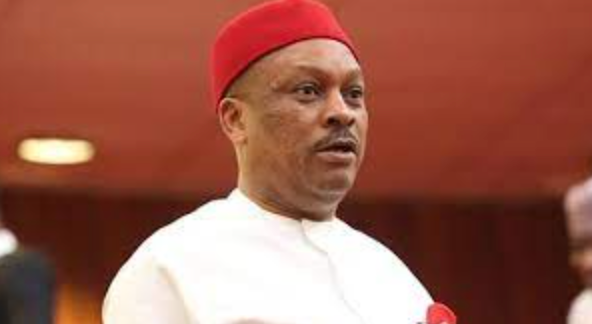
Nigeria’s main opposition party, the Peoples Democratic Party (PDP), is teetering on the edge of a full-blown leadership rupture as powerful zonal chairmen move to seize control in anticipation of a potentially explosive court ruling on Samuel Anyanwu.
Behind closed doors, influential figures within the party’s National Working Committee (NWC) are weighing a dramatic contingency plan: invoke the doctrine of necessity, dissolve the current leadership uncertainty, and install an interim national leadership drawn from among themselves.
At the heart of the storm is Anyanwu’s disputed status as National Secretary. If the courts uphold his expulsion and invalidate conventions tied to his authority, party insiders warn of a dangerous vacuum at the top.
“We cannot allow the party to drift,” a senior zonal chairman confided. “If the courts nullify those conventions, we will step in. Leadership must not collapse.”
A Party on the Brink
The crisis stems from a tangled web of legal battles and factional rivalries that have left the PDP deeply fractured. Competing conventions, conflicting court rulings, and bitter political alignments have all converged into what insiders now describe as a “make-or-break moment.”
Should the judiciary rule against Anyanwu, the implications could be sweeping. Key decisions—ranging from party conventions to official communications with the electoral body—may be declared invalid.
Already, anxiety is spreading across party ranks.
Another zonal leader acknowledged the uncertainty but hinted at readiness:
“A doctrine of necessity may become inevitable. If there is no legally recognised leadership, we must act to stabilise the party.”
Yet, not all voices support immediate action. Babangida Maddibo, the North-East Zonal Chairman, urged caution:
“We should not put the cart before the horse. Let the court speak first.”
Legal Firestorm and INEC Pressure
The unfolding power struggle has now spilled into Nigeria’s electoral space. A rival bloc aligned with Tanimu Turaki has formally petitioned the Independent National Electoral Commission (INEC), demanding the immediate derecognition of Anyanwu.
Citing a January 2026 ruling of the FCT High Court, the faction insists that Anyanwu ceased to be a party member upon his expulsion and therefore lacks any authority to act on behalf of the PDP.
Their argument is blunt: any action taken by an expelled member—including organising the controversial March 2026 convention—amounts to a legal nullity.
If accepted, the fallout could be seismic.
Wike Camp Pushes Back
But the camp loyal to Nyesom Wike has dismissed the expulsion narrative as fundamentally flawed.
According to the faction, the disciplinary process that recommended Anyanwu’s removal—linked to a committee once chaired by Tom Ikimi—was never properly ratified by the party’s highest organs.
They argue that no valid expulsion ever took place and that the March 29–30 Abuja convention, which produced a new leadership, was legally sound and duly recognised by INEC.
A House Built on Uncertainty
Legal experts say the stakes could not be higher. If the courts affirm Anyanwu’s expulsion, the entire structure built around his actions could unravel overnight.
“All his actions may be void,” one senior lawyer noted. “You cannot represent an organisation you no longer belong to.”
Yet others caution that due process will be decisive—raising questions about whether the expulsion itself followed constitutional procedures within the party.
The Waiting Game
For now, the PDP stands at a crossroads—caught between courtroom verdicts and internal survival instincts.
With factions digging in and contingency plans quietly unfolding, the party’s immediate future may hinge on a single judicial pronouncement.
Until then, one reality looms large: the battle for the soul of the PDP has entered its most निर्णative phase yet.
ADVERTISEMENTS