


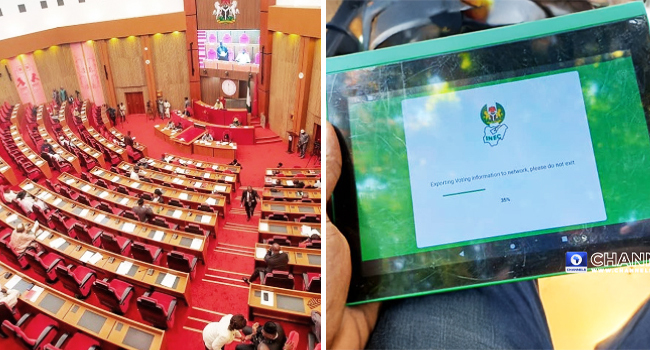
The Senate on Wednesday passed the Electoral Act 2022 (Repeal and Re-enactment) Amendment Bill 2026 after it scaled through its third reading, retaining the existing legal framework on the transmission of election results.
Lawmakers rejected a proposed amendment to Clause 60(3) that sought to make electronic transmission of election results mandatory. The rejected provision would have required presiding officers of the Independent National Electoral Commission (INEC) to transmit polling unit results electronically to the IReV portal in real time, immediately after completing and endorsing Form EC8A.
Instead, the Senate adopted the current provision of the Electoral Act, which states that “the presiding officer shall transfer the results, including the total number of accredited voters and the results of the ballot, in a manner as prescribed by the Commission.”
Addressing concerns over the decision, Senate President Godswill Akpabio insisted that the legislature did not vote against electronic transmission of results.
“Electronic transmission has always been in our Act,” Akpabio said. “What we did was to retain the existing provision, which already accommodates electronic transmission.”
He added that there was no intention to delay or frustrate the amendment of the Electoral Act.
Earlier during clause-by-clause consideration, the Senate rejected a proposal under Clause 22 to impose a 10-year jail term on individuals involved in the buying or selling of Permanent Voter Cards (PVCs). Lawmakers instead retained the existing two-year imprisonment term while increasing the fine from ₦2 million to ₦5 million.
The upper chamber also amended Clause 28 on the notice of election, reducing the timeline for INEC to publish election notices from 360 days to 180 days before the election date.
Similarly, Clause 29 was amended to shorten the deadline for political parties to submit lists of candidates and affidavits to INEC from 180 days to 90 days before the election. The revised clause stipulates that only candidates who emerge from valid party primaries may be submitted.
The Senate retained Clause 44 on the format of ballot papers, which requires INEC to invite political parties, at least 20 days before an election, to inspect samples of electoral materials bearing their identities. Parties are expected to respond within two days, indicating approval or objections.
Under Clause 47, lawmakers replaced the smart card reader with the Bimodal Voter Accreditation System (BVAS) for voter accreditation. However, they rejected electronically generated voter identification, maintaining the Permanent Voter Card as the sole means of voter identification at polling units.
The Senate also struck out Clause 142 on the effect of non-compliance, which would have allowed documentary evidence alone to establish electoral non-compliance without oral testimony. Lawmakers argued that the provision could lead to procedural abuse and unnecessary litigation.
At the conclusion of deliberations, the Senate announced the constitution of a conference committee to harmonise differences between the Senate and House of Representatives versions of the bill. The committee will be chaired by Senator Tahir Munguno.
ADVERTISEMENTS













2026-02-04


Previous Post: Tin Can Customs Records ₦1.6tn Revenue in 2025,