
President Bola Ahmed Tinubu has called on the World Bank to deepen its support for Nigeria’s ongoing economic reforms, with a strong focus on agricultural transformation, youth employment, and private sector–led growth.
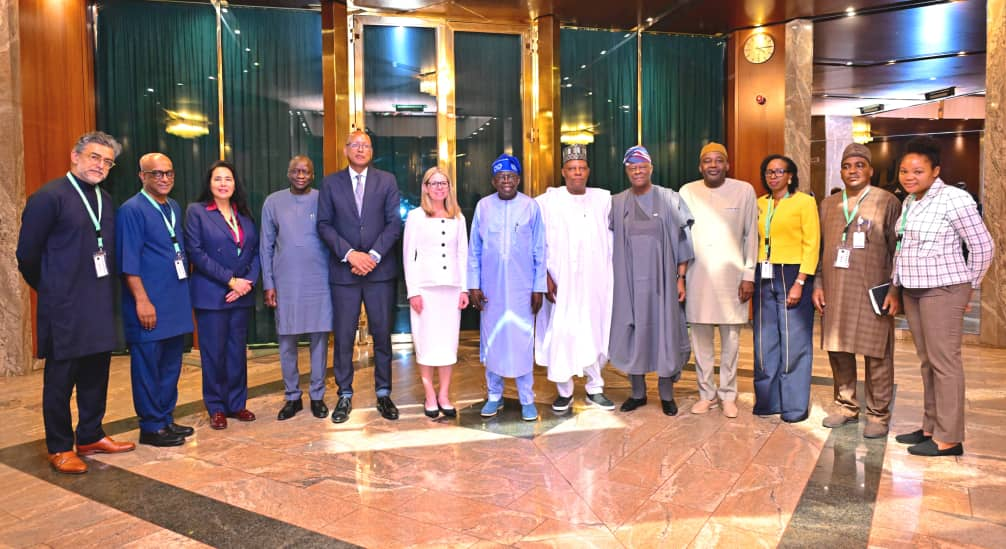
The President made the appeal on Tuesday while receiving a delegation from the World Bank, led by its Managing Director of Operations, Anna Bjerde, at the Presidential Villa, Abuja.
Tinubu said his administration remains fully committed to its reform agenda despite initial challenges, stressing that the policies are already yielding results.
“Since we went into this tunnel of reform, we have our hands on the power and we are not going to look back. Initially, it was painful and difficult, but those who succeed are not the ones who give up in hard times,” the President said.
He underscored the importance of modernising agriculture through mechanisation to boost productivity and create opportunities for Nigeria’s large and growing youth population.
“We are establishing mechanisation centres to support farmers with improved seedlings and fertilisers. Our goal is to move farmers from subsistence practices to large cooperatives that can create jobs and sustainable opportunities for Nigerians,” Tinubu explained.
The President also identified the petrochemical sector and other domestic industries as priority areas for increasing local production and strengthening internal markets. He noted that economic reforms must be continuous and anchored on transparency, accountability, and stability.
“The first reaction to reforms was high inflation, but inflation has come down significantly, and the naira is now stable. We want to make it easier for investors to operate, reduce bureaucracy, and build the skills of our people,” he added.
In her remarks, Anna Bjerde commended the Tinubu administration for maintaining a consistent and disciplined reform trajectory over the past two years, describing Nigeria as a growing global example of reform implementation.
“The results achieved in the last two years are commendable. Your steady communication of the importance of reforms has given investors and policymakers confidence. There is no turning back,” she said.
Bjerde highlighted job creation as a critical priority, particularly for Nigeria’s youth, noting that small and medium-sized enterprises (SMEs) remain central to employment growth across Africa.
“Agriculture is a major employer and a key driver of the economy. Innovations in mechanisation, cooperative models, value-chain development, and infrastructure can be scaled to create more opportunities,” she said.
She also outlined the World Bank Group’s financial engagement with Nigeria, including $17 billion in public sector financing, $5 billion in private sector support through the International Finance Corporation (IFC), and over $500 million in investment guarantees.
According to her, these financial instruments are aligned with Nigeria’s reform priorities in trade, digital development, inflation management, and human capital development.
“We want to work with Nigeria to accelerate growth, expand access to finance for SMEs, and support early childhood development as part of a comprehensive human development strategy,” Bjerde said.
The meeting reaffirmed Nigeria’s drive to mobilise international support for strategic reforms, particularly in sectors critical to food security, youth employment, and sustainable economic growth.
ADVERTISEMENTS